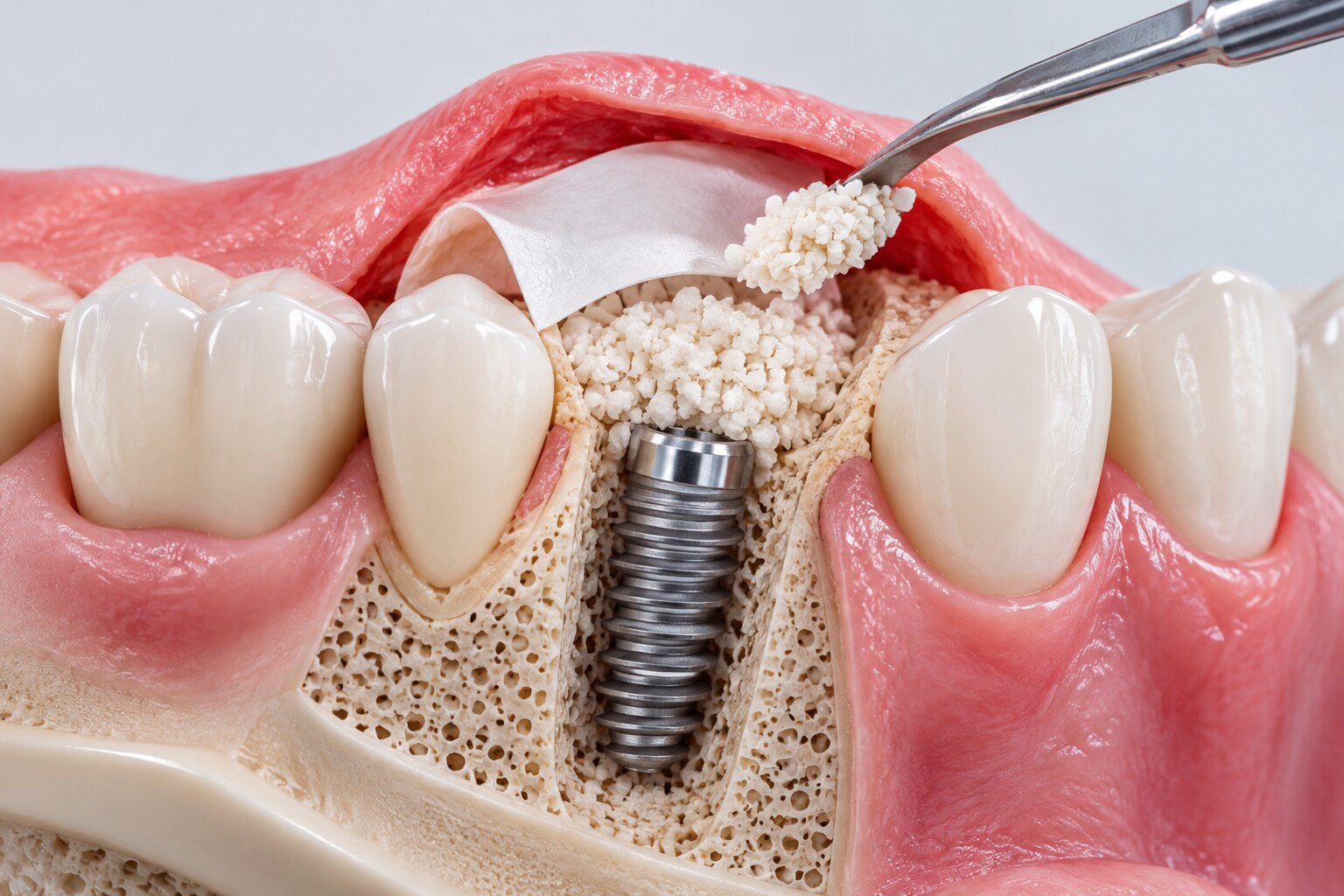
The right augmentation method depends on the shape and location of the bone defect, not simply on how long a tooth has been missing. By the end, you will be able to distinguish graft types, understand when treatment is staged, and compare a proposed plan with the findings that should support it.
Key takeaways
- Match horizontal, vertical or sinus defects to the correct augmentation method.
- Socket preservation protects an extraction site; it does not rebuild every ridge defect.
- Compare graft material, membrane use, fixation and healing time before choosing a plan.
- Use CBCT imaging, medical history and implant measurements to assess grafting safety.
Which augmentation method matches the bone defect?
A defect’s shape determines the augmentation method: horizontal width loss, vertical height loss, both, or insufficient bone beneath the maxillary sinus. “Alveolar bone augmentation” is an umbrella term, not a single operation. For anyone comparing alveolar bone augmentation types in Borivali, the diagnosis matters more than the locality.
| Option | Defect addressed | Typical purpose |
|---|---|---|
| Socket preservation | Fresh extraction socket likely to collapse | Maintains ridge width and height after tooth removal; it does not rebuild a severely resorbed ridge |
| Particulate graft with guided bone regeneration | Local horizontal defect, or a contained small vertical defect | Adds volume under a barrier membrane that blocks soft-tissue invasion |
| Block bone graft | Severe, narrow horizontal loss or selected vertical defects | Rebuilds a larger three-dimensional deficiency; fixation and a donor site may be required |
| Ridge split or ridge expansion | A narrow ridge with adequate height and cancellous bone | Widens the ridge by separating or expanding its plates, sometimes with simultaneous implant placement |
| Vertical ridge augmentation | Major loss of ridge height | Builds height when the implant lacks sufficient vertical support; healing and complication risks are greater |
| Sinus-floor elevation | Short bone height in the posterior upper jaw | Raises the sinus lining; transcrestal access suits smaller deficiencies, while a lateral window gives greater access |
Alveolar graft options Mumbai patients compare also include autogenous bone, allograft, xenograft and synthetic materials. The choice affects resorption, healing and donor-site surgery, but it does not replace stable coverage or infection control. Treat active periodontal disease, untreated decay and uncontrolled systemic illness before elective grafting.
Socket preservation, ridge grafting and sinus procedures are not interchangeable
Extraction-site treatment preserves what remains; later treatment rebuilds bone that has already resorbed. After removing a tooth, the socket walls can shrink rapidly, especially in width, so socket preservation fills the fresh space with graft material and may use a membrane. It protects the future implant site but does not recreate every lost dimension.
| Procedure | Defect and timing | Main purpose |
|---|---|---|
| Socket preservation | Immediately after extraction; contained socket | Limit collapse before ridge volume is lost |
| Horizontal ridge grafting | Months or years later; narrow ridge | Add width with particulate grafting, membrane, block graft or ridge expansion |
| Vertical ridge augmentation | Established height loss | Build height, often in a staged operation with fixation |
| Sinus-floor elevation | Posterior upper jaw with limited height beneath the sinus | Lift the sinus lining and add grafted height for an implant |
A small, contained horizontal defect can sometimes be grafted during implant placement when the implant achieves primary stability. A large, non-contained or vertical defect usually needs grafting first and a healing interval before implant placement; staging signals defect size, not treatment failure.
Sinus procedures are not ordinary ridge grafts. A transcrestal lift suits a smaller vertical deficiency, while a lateral-window approach gives access for greater augmentation after reviewing residual bone height, sinus anatomy and the implant plan.
If you are comparing bone augmentation for dental implants borivali, ask for the defect diagnosis and whether the proposed procedure addresses width, height or sinus-related bone loss.
How graft material, membranes and fixation change the operation
The graft choice affects both the surgical burden and how the new bone gains strength.
| Option | Main advantage | Main trade-off |
|---|---|---|
| Autogenous bone | Living bone-forming cells and growth factors from your own bone | Requires a second surgical site, such as the chin or jaw |
| Allograft | Avoids donor-site surgery and is available as particulate or block material | Relies on incorporation and replacement by your bone |
| Xenograft | Provides a stable scaffold that resorbs slowly | Remains as scaffold material for longer and does not supply your living cells |
| Synthetic alloplast | No human or animal donor material; composition is predictable | Bone formation depends on your vascularity and healing response |
A membrane is needed when particulate graft must be protected from fast-growing gum tissue, as in guided bone regeneration. It creates a sheltered space, but exposure, contamination, wound opening and graft loss become concerns if healthy tissue does not cover it.
A screw stabilises a block graft or a large particulate graft. Movement during healing can leave a fibrous gap instead of solid bone. A titanium mesh holds graft volume in a wide or vertical defect when a membrane alone would collapse; exposure remains a key complication.
For an alveolar bone graft Borivali consultation, ask which material is proposed, why it suits the defect, and whether fixation is needed. Also ask whether implant placement is simultaneous or staged and what examination will confirm readiness. Availability of a material should not decide the operation; defect shape, blood supply and stability should.
What examination determines whether grafting is safe and useful?
A clinical examination plus 3D imaging determines whether augmentation is safe and useful. Request a recent CBCT scan, panoramic radiograph, periapical films, intraoral photographs, periodontal charting and the extraction history. CBCT shows ridge width, height, vital structures, sinus anatomy and the defect’s containment.
Before surgery, review:
- Active periodontal infection, untreated caries, swelling, drainage and plaque control; these must be treated first because grafting cannot overcome continuing bacterial inflammation.
- Blood pressure, diabetes control, osteoporosis treatment, immune disorders, previous head-and-neck radiation and medicines such as bisphosphonates, denosumab, corticosteroids and anticoagulants.
- Smoking, vaping, smokeless tobacco, alcohol use, bruxism and previous problems with wound healing. Record tobacco use openly; smoking is linked with poorer healing and more implant complications.
- The proposed implant position, available primary stability and whether the defect is horizontal, vertical, combined, large or non-contained.
| Finding | What it changes | Possible plan |
|---|---|---|
| Contained horizontal defect with stable implant site | The graft can remain protected | Same-day augmentation and implant placement |
| Large, vertical or non-contained defect | The graft needs stability and undisturbed healing | Staged grafting, reassessment, then implant placement |
| Untreated infection or uncontrolled disease | Healing and implant integration are threatened | Treat the condition before elective surgery |
Ask the dental bone graft clinic in Borivali to state the reassessment criteria, not promise one fixed healing period. Material, defect size, blood supply, membrane or block stability and simultaneous implant placement all alter timing.
How to compare a staged or same-day plan in Borivali
A staged plan places the graft first and the implant after healing confirms usable bone; a same-day plan places both during one operation. Search results for bone augmentation for dental implants borivali are less useful than a written explanation of why your defect and implant position suit one sequence.
| Plan | Healing and review | Main trade-off |
|---|---|---|
| Staged | Graft review uses wound healing, graft stability and follow-up imaging before implant placement | Two surgical phases, but the implant is placed after bone gain is assessed |
| Same-day | Implant stability is checked immediately; later reviews assess graft integration and soft-tissue healing | Fewer operations, but graft failure or poor initial stability can complicate the implant plan |
Ask these questions before consenting:
- What are the defect measurements: horizontal width, vertical height, or both, and what bone must exist around the planned implant?
- Which material, membrane, screw or mesh will you use, and what finding allows implant placement at the next checkpoint?
- If the posterior upper jaw is involved, is a transcrestal sinus-floor elevation enough for a smaller vertical deficiency, or is a lateral-window approach needed for greater access? How do residual bone height, sinus anatomy and the implant plan determine this?
- What happens if the membrane opens, the graft becomes infected, the sinus membrane tears, or the implant lacks stability?
- Which smoking, periodontal infection, caries or medical risks must be controlled first?
Dr. Karan Mehta's Mouth Jaw Face & Hair Transplant should document the proposed sequence, operator credentials, review dates and complication plan rather than promise a fixed healing period. An alveolar bone graft borivali consultation is stronger when those details appear in your treatment plan.
Related service
Jaw Alveolar bone is a part of jaw bones which houses the teeth. Upon looseing or removing teeth the bone slowly resorbs or reduces in size. View service → |
Frequently asked questions
Which alveolar bone augmentation method matches the defect?
Horizontal width loss usually needs ridge augmentation, vertical height loss needs vertical augmentation, and combined loss needs a tailored grafting plan. Bone deficiency beneath the maxillary sinus may require sinus augmentation.
Are socket preservation, ridge grafting and sinus procedures interchangeable?
No. Socket preservation fills an extraction socket, ridge grafting rebuilds deficient width or height, and sinus augmentation creates vertical bone beneath the upper-jaw sinus.
How do graft materials, membranes and fixation affect the operation?
The defect and surgical plan determine whether the surgeon uses autogenous, donor, animal-derived or synthetic graft material, a barrier membrane, screws, pins or another stabilisation method. These choices affect healing, protection and follow-up.
What examination determines whether grafting is safe and useful?
A clinical examination, dental radiographs and three-dimensional CBCT imaging assess ridge dimensions, sinus anatomy, teeth, infection and vital structures. Your medical history and implant position also affect the decision.
How should you compare a staged and same-day implant plan in Borivali?
Compare the available bone, infection status, primary implant stability, graft size, healing period, number of procedures and follow-up requirements. Same-day placement is unsuitable when the implant cannot be stabilised safely.
Keywords