Sparse eyebrows can result from over-plucking, scars, burns, trauma, inherited patterns or an active medical condition, and each cause changes the safest next step. You will be able to judge your suitability, prepare for an eyebrow transplant, compare alternatives, and assess recovery expectations before choosing a clinic.
Key takeaways
- Identify the cause of eyebrow loss before choosing transplantation.
- Request a brow design that matches your facial proportions and natural growth direction.
- Confirm donor-hair suitability, surgical steps, aftercare and expected timeline.
- Judge results after full growth, not during early shedding or redness.
Is eyebrow transplantation suitable for your type of hair loss?
A consultation must identify why your eyebrow is sparse before anyone discusses eyebrow transplant treatment. The clinician should assess the brow skin, scars, hair-loss pattern, medical history, medications and donor hair rather than treating every case as simple cosmetic thinning.
Suitable candidates can include people with:
- Over-plucked eyebrows or congenital sparse eyebrows
- Stable hair loss after a scar, burn or trauma
- Selected hair-loss conditions after diagnosis and disease control
Delay or avoid surgery when you have:
- Active alopecia areata
- Scarring alopecia or another inflammatory skin disease
- Untreated thyroid-related hair loss
- Insufficient donor hair
- Unrealistic expectations about density or perfect symmetry
Transplanting into active inflammation or uncontrolled disease can lead to poor growth or renewed loss. An eyebrow restoration clinic Mumbai patients consider should explain the diagnosis and disease activity before proposing surgery.
Treating the underlying disease, observing stable changes, or using camouflage cosmetics may be better first steps. Microblading and other tattoo-based methods create the appearance of brow hairs but do not produce growing follicles.
Transplantation adds living follicles, yet it also brings surgical risks, possible scarring, infection, uneven growth and lifelong trimming because scalp hair keeps growing longer than native brow hair. Choose surgery only after a medical assessment confirms a stable problem, adequate donor supply and realistic goals.
What should happen during the consultation and brow design?
Treat the consultation as a planning appointment, not a promise of a fixed graft count. The clinician should review your medical history, prior trauma or procedures, hair-loss progression, prescriptions, vitamins, supplements, smoking, alcohol use and conditions such as thyroid disease or inflammatory skin disorders.
The examination should record donor density, scalp and brow skin quality, scars, existing symmetry and the intended head, body, arch and tail. Ask whether scalp hair is suitable, whether beard or other body hair is being considered, and who will diagnose, design, extract and place the grafts.
- Have the brow design marked directly on your face before consenting. Check the planned width, arch position, head-to-tail length and density while sitting upright, because a design that looks balanced when lying down can appear uneven when you stand.
- Discuss acceptable asymmetry. Human brows are not identical, and forcing perfect symmetry can create an unnatural shape or require excessive grafting.
- Review the graft plan zone by zone. Eyebrow reconstruction uses mostly single-hair follicular units distributed across the head, central body, arch and tail, rather than packed uniformly.
- Ask how the plan changes for a scar or near-total loss. Excessive density can look artificial, while scar tissue may support poor growth; either problem can require staged treatment.
- Confirm the surgical team and method in writing. For an eyebrow transplant procedure in Mumbai or an eyebrow hair transplant in Borivali, you should know which clinician performs each surgical step and who handles complications or revision.
How is the procedure performed, and how does it compare with other brow options?
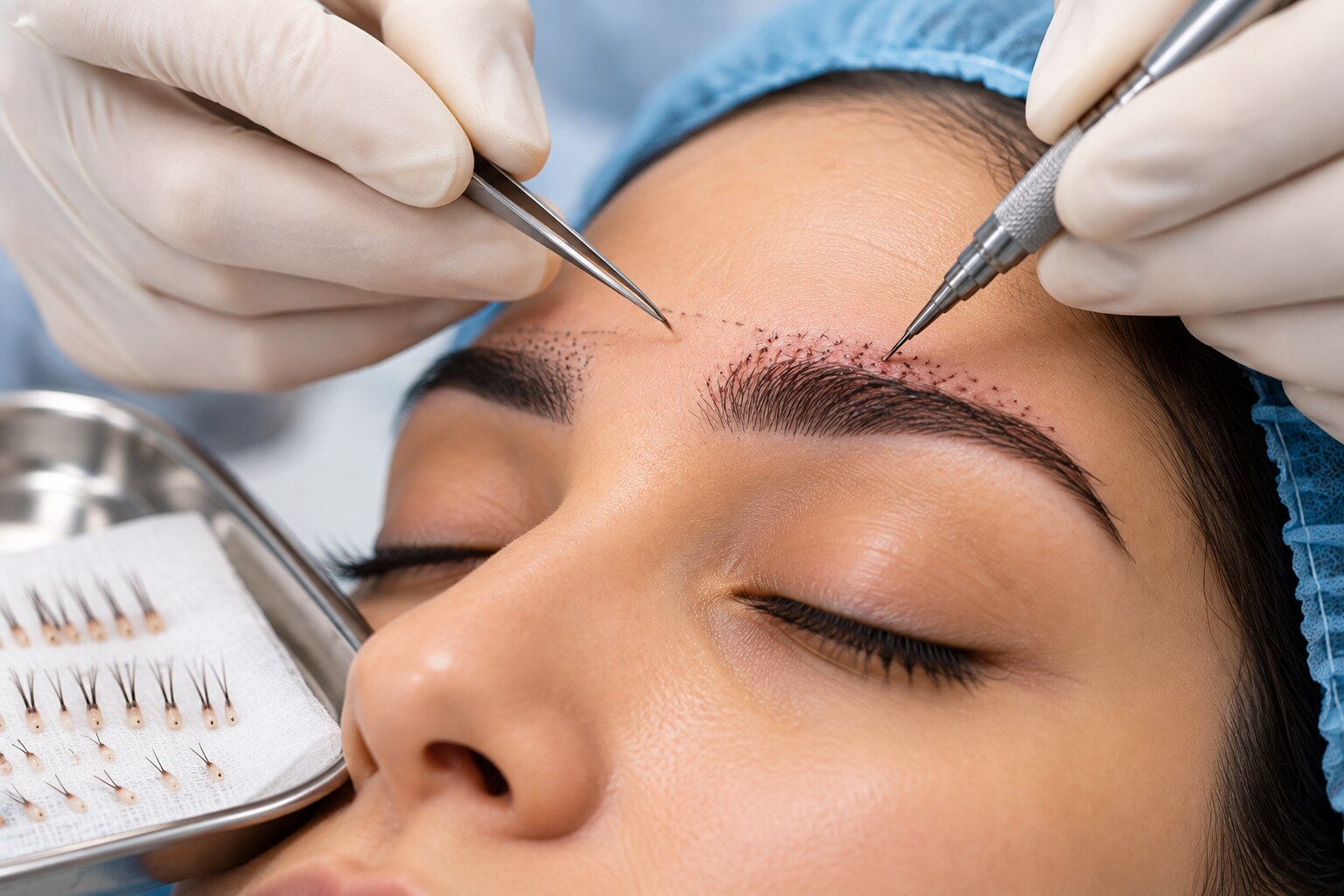
An eyebrow transplant procedure in Mumbai is usually an outpatient operation under local anaesthesia. With FUE, the clinician removes individual follicular units through small punch openings, usually from the occipital or temporal scalp. FUE is not scarless: it can leave multiple small, pale scars.
FUT removes a strip of scalp, leaves a linear donor scar and can suit a larger harvest.
The recipient sites are made very shallow. Mostly single-hair grafts are inserted at carefully controlled angles and directions for the medial, central and lateral brow zones. Deep or vertical placement, clustered grafts or inconsistent orientation can make surviving hairs look pluggy rather than natural.
The method, operating time and graft number depend on a small defect, diffuse thinning, a scar or near-total loss; extensive loss may require staged treatment.
| Option | What it does | Main limitation |
|---|---|---|
| Temporary makeup | Adds colour and apparent fullness | Washes off and grows no hair |
| Microblading or tattoo methods | Creates a drawn brow shape | Creates no living hairs and can change colour or blur |
| FUE eyebrow transplantation | Adds living follicles | Requires surgery, healing and lifelong trimming |
| Brow or forehead lift | Raises or repositions existing brows | Does not restore missing hairs |
An eyebrow transplant treatment is therefore different from camouflage or repositioning. Scalp hair keeps growing faster and longer than eyebrow hair, so regular grooming remains necessary.
How should you prepare, and what happens during recovery?
Before eyebrow transplant surgery for Borivali, complete this preparation checklist:
- Tell the clinician about every prescription, over-the-counter medicine, vitamin and supplement.
- Ask which products require adjustment before or after surgery.
- Report drug allergies, anaesthetic reactions and eczema, psoriasis, dermatitis or other skin disease.
- Follow the clinician’s specific instructions about smoking and alcohol.
- Arrange transport if sedation is used, and do not change or stop medication without medical advice.
The appointment is usually outpatient. Use the clinic’s own instructions for washing, prescribed medication, exercise and rubbing restrictions; generic internet advice cannot replace them. Early aftercare focuses on preventing graft dislodgement, not merely keeping the area clean.
| Time | Expected change | What it means |
|---|---|---|
| First days | Swelling, bruising, crusting, itching or temporary numbness | Protect grafts while the skin heals |
| Early weeks | Folliculitis, ingrown hairs or temporary shedding | Initial shafts do not represent final density |
| Several months | Visible regrowth begins | Judge progress gradually |
| About 9–12 months | Hair direction and thickness mature | Assess the cosmetic result |
Contact the surgical team for increasing pain, spreading redness or swelling, pus, fever, persistent bleeding, wound separation or rapidly worsening symptoms. Report troublesome folliculitis or ingrown hairs rather than picking them. Eyebrow transplant treatment requires patience: implanted follicles, not the first visible shafts, determine the eventual result.
How do you choose a Borivali clinic and judge the long-term result?
Choose the provider by responsibility, not by the clinic’s title or distance from home. Ask who diagnoses the cause of loss, who designs the brow, who extracts and places grafts, and who manages infection, poor growth, asymmetry and revision surgery. These answers matter more than proximity for eyebrow transplant surgery for Borivali.
At a Mumbai consultation, request photographs with matching lighting, camera angles, hair length and follow-up timing. Compare results at about six and 12 months; immediate images mainly show temporary shafts and the planned design, not final growth.
Ask specifically about these long-term risks:
- Scalp donor hair keeps growing faster and longer than native eyebrow hair, so trimming and shaping may be lifelong; some patients also need curling.
- FUE can still leave visible donor or recipient scars, while cysts, poor graft growth and unnatural hair direction can affect the result.
- An over-dense design or badly oriented grafts may need revision, and revision cannot always correct it.
For an eyebrow hair transplant Borivali comparison, use this framework:
| Provider check | What to verify | Warning sign |
|---|---|---|
| Diagnosis | Cause, disease activity and donor supply | Surgery offered without diagnosis |
| Design | Arch, width, density and acceptable asymmetry | Fixed graft count or copied shape |
| Evidence | Six- and 12-month standardized photographs | Only immediate post-operative images |
| Aftercare | Infection, poor growth and revision plan | No named complication manager |
An eyebrow restoration clinic Mumbai patient may assess Dr. Karan Mehta's Mouth Jaw Face & Hair Transplant in Borivali West using these same questions, rather than treating location as proof of suitability.
Related service
Hair Here's how the eyebrow transplantation process generally works: Donor Hair Extraction: The surgeon will first identify a suitable donor area on the... View service → |
Frequently asked questions
Is eyebrow transplantation suitable for every type of eyebrow hair loss?
No. A consultation should examine the brow skin, scars, hair-loss pattern, medical history, medications and donor hair before treatment. Active skin disease or an unsuitable donor area can change the recommendation.
What should happen during an eyebrow transplant consultation?
The clinician should discuss the cause of thinning, examine the donor area and design the brow shape, density, hair direction and symmetry before surgery.
How does an eyebrow transplant compare with other brow options?
A transplant uses your own donor hair for a longer-term result, while pencils, powders, tinting and cosmetic tattooing create temporary or pigment-based changes. The options differ in maintenance, invasiveness, colour and growth direction.
What happens during recovery after eyebrow transplant surgery?
Expect temporary redness, swelling, crusting and shedding during early recovery. Follow washing and activity instructions, protect the grafts and wait for new growth to develop before judging the final result.
How do you choose an eyebrow restoration clinic in Mumbai?
Review the clinician’s qualifications, consultation process, brow-design method, donor-hair assessment, before-and-after cases and written aftercare plan. Ask who performs each surgical step and how complications are handled.
Keywords