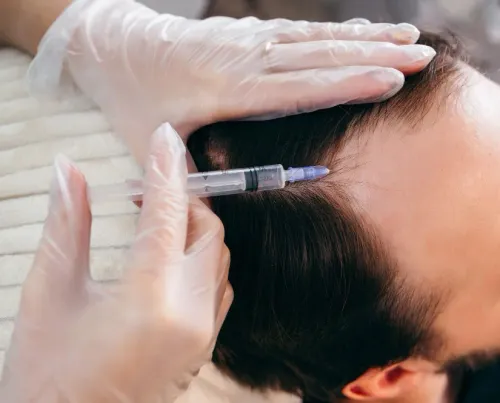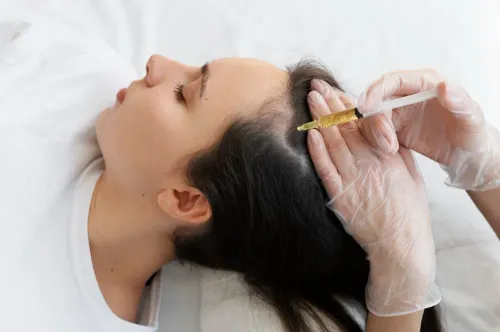
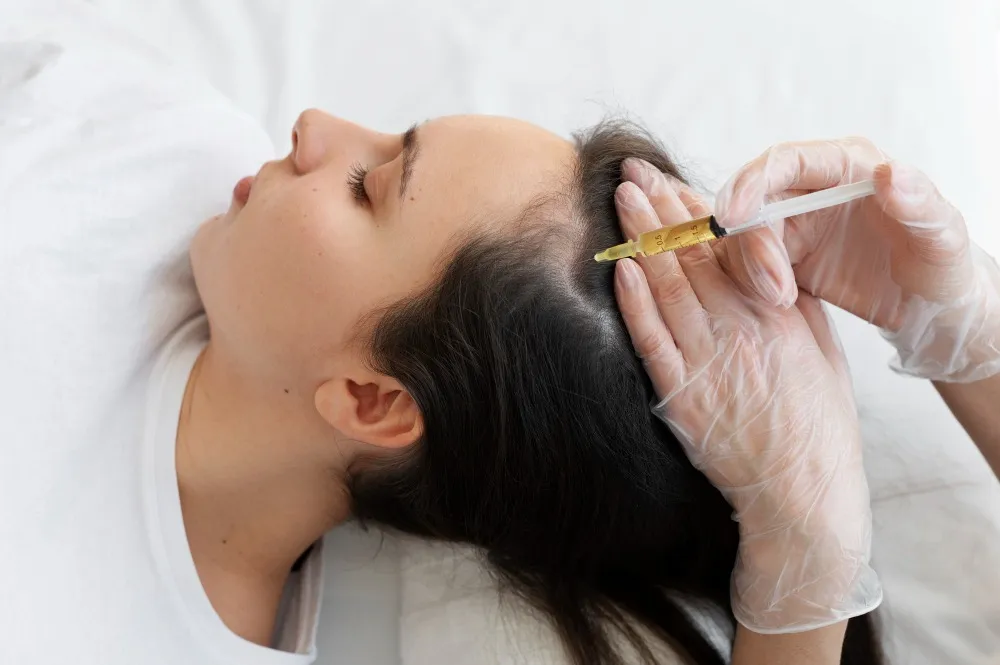
Platelet-rich plasma therapy, commonly known as PRP, is a non-surgical procedure used in selected hair-loss treatment plans. It uses a concentrated portion of the patient’s blood containing platelets and growth-related proteins, which is then injected into targeted areas of the scalp.
Mouth Jaw Face Clinic (MJF Clinic) is led by Dr. Karan Mehta, an Oral and Maxillofacial Surgeon with a Fellowship in Aesthetic Medicine from ILLAMED, affiliated with Greifswald University, Germany. His training includes hair transplant surgery and related hair-restoration planning, supporting the clinical assessment needed to determine whether PRP is appropriate.
How Is PRP Prepared?
A measured quantity of blood is drawn from the patient, similar to a routine blood test. The sample is placed in a centrifuge, which spins it to separate its components. The platelet-rich portion is then collected and prepared for scalp injections.
A typical appointment may involve:
- Examining the scalp and identifying treatment areas
- Drawing a small blood sample
- Processing the sample through centrifugation
- Cleaning or numbing the scalp as required
- Injecting PRP into selected points
- Providing post-procedure instructions
Since the preparation comes from the patient’s own blood, PRP does not use donor tissue. However, it remains a medical procedure and should be performed under appropriate clinical conditions.
Who May Consider PRP Hair Treatment in Borivali West?
PRP is generally considered when hair follicles are still present but are producing progressively finer or weaker hair. It may be included in a broader treatment plan for selected men and women with early pattern thinning.
Before recommending PRP, the doctor should evaluate:
- Type and duration of hair loss
- Pattern and degree of thinning
- Whether shedding is currently active
- Extent of follicle miniaturisation
- Scalp health
- Medical history and medicines
- Previous hair-loss treatment
- Possibility of an underlying deficiency or condition
PRP is less likely to provide meaningful coverage over smooth, long-standing bald areas where active follicles are no longer present. It also cannot replace appropriate treatment for an infection, deficiency, hormonal concern or inflammatory scalp disorder.
How Many Sessions May Be Required?
PRP is usually planned as a course rather than a one-time procedure. The number and spacing of sessions depend on the diagnosis, degree of thinning, individual response and treatment protocol.
Visible improvement takes time because hair grows in cycles. Early changes may include reduced shedding, followed by possible improvement in hair thickness or density. Progress is better measured through standardised photographs and clinical examination.
Results vary between patients, and treatment cannot guarantee identical growth or density for everyone. Maintenance sessions may be discussed depending on the initial response and progression of hair loss.
What Happens After PRP?
Temporary redness, tenderness, pinpoint bleeding, swelling or a feeling of scalp tightness may occur. Patients may be advised to avoid vigorous rubbing, selected hair products, heat exposure or strenuous exercise for a limited period.
Anyone taking blood-thinning medicine or managing an active scalp infection or significant medical condition should mention this before treatment. Medicines should not be stopped without appropriate medical advice.
Is PRP Enough on Its Own?
PRP may be used independently in selected cases, but it is often considered alongside medical treatment, nutritional correction or scalp care. Patients with advanced permanent hair loss may require evaluation for hair transplantation instead.
Considering PRP hair treatment in Borivali? Consult Dr. Karan Mehta at MJF Clinic for a scalp evaluation and personalised guidance on whether PRP, combined treatment or another hair-restoration option is suitable.
Keywords