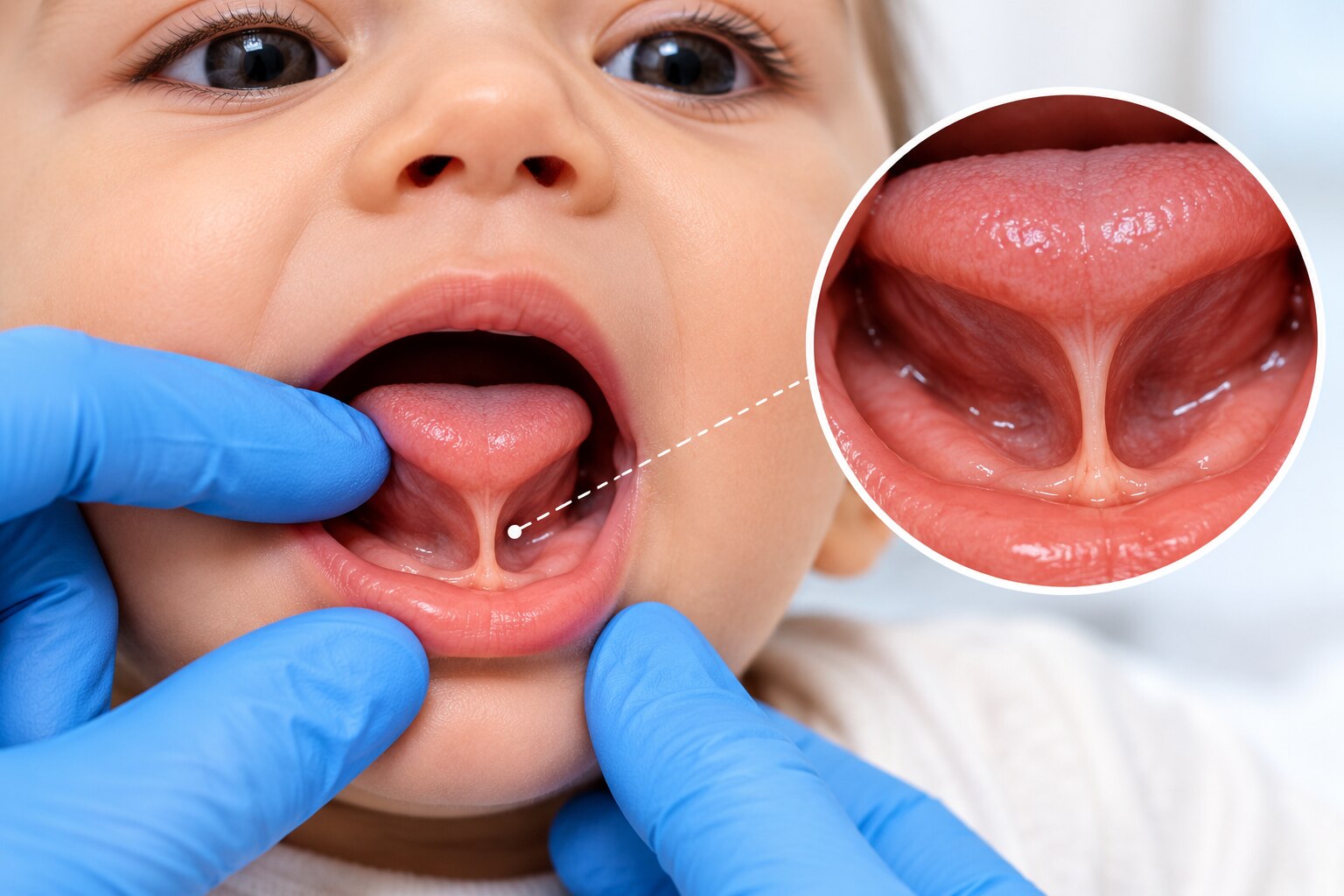
A short-looking lingual frenulum does not prove that an adult needs surgery. You need to connect restricted movement with a specific problem, rule out other causes, and compare release depth, anaesthesia, clinician training, follow-up and total cost before choosing a Mumbai provider.
Key takeaways
- Match restricted tongue movement to a specific speech, eating or oral-care problem.
- Try targeted therapy or observation when symptoms are mild or the diagnosis is uncertain.
- Compare laser and scalpel technique, not the marketing label alone.
- Ask about assessment, aftercare, complications and the surgeon’s adult cases.
How to tell whether an adult tongue tie is causing a problem
An adult tongue tie is more likely to be a problem when restricted tongue movement matches a specific difficulty, not when the frenulum merely looks short. Useful assessment follows these steps:
1. Test elevation. Ask whether you can lift the tongue toward the upper front teeth or palate without the tongue tip curling, the floor of the mouth lifting, or the jaw compensating.
2. Test reach and control. Check protrusion, side-to-side movement, and whether you can sweep food from both cheeks. Note oral fatigue, difficulty cleaning around the teeth, swallowing changes, speech concerns, and neck or jaw tension.
3. Look for another explanation. Assessment should consider jaw structure, dental crowding, scar tissue, muscular coordination problems, temporomandibular disorders, nasal obstruction, sleep-related breathing problems, reflux, and an established speech disorder.
4. Link the symptom to the restriction. Surgery is less likely to help when the frenulum is incidental or no complaint has been connected to tongue movement. Speech improvement is not guaranteed; persistent articulation problems may need a speech-language assessment and therapy.
5. Treat grading as a description, not a verdict. No single tongue-tie grading scale decides treatment for every adult. A clinician should document measurable movement limits, functional symptoms, and the expected benefit before discussing tongue tie treatment options. A photograph alone cannot establish the need for release.
Adult tongue tie treatment options: therapy, observation or release
The main adult tongue tie treatment options are observation, therapy and release surgery. Observation is reasonable when tongue movement is adequate and symptoms are absent or mild; a short-looking frenulum alone does not prove that treatment is needed.
Myofunctional therapy or speech-language therapy can improve tongue coordination, swallowing and articulation. Therapy before surgery can clarify whether restricted movement is causing the complaint, while therapy afterward helps build new movement patterns. Surgery does not guarantee better speech.
| Option | What it means | When it applies |
|---|---|---|
| Observation | No procedure; monitor function and symptoms | Movement is adequate and symptoms are absent or mild |
| Myofunctional or speech-language therapy | Exercises and guided retraining for movement, swallowing or speech | Coordination is the main problem, or before or after release |
| Frenotomy | A release incision divides the frenulum | A straightforward functional restriction needs release |
| Frenectomy | More frenulum tissue is removed | A larger amount of restrictive tissue requires removal |
| Frenuloplasty | The release is reshaped or lengthened, commonly with sutures | A deeper release is needed or a simple incision could leave a tight scar |
Terminology varies between surgeons. Ask whether tissue will be divided, removed, reshaped or sutured, and whether prescribed mobility exercises are part of the plan. A combined release and rehabilitation programme may be chosen when the expected benefit depends on retraining.
People searching tongue tie surgery Mumbai should compare the planned release and rehabilitation, not only the clinic’s procedure label.
Laser or scalpel? Compare the procedure, not the marketing label
Laser does not automatically mean a better adult release. It can provide precise cutting and haemostasis, but evidence does not establish universal superiority over a cold instrument or electrosurgery. Thermal injury remains a concern, so ask about wavelength-specific eye protection, equipment maintenance and the operator’s training.
The more important question is what tissue will be released. A superficial frenotomy makes an incision; a frenectomy removes more frenulum tissue; a frenuloplasty reshapes or lengthens a deeper release and commonly uses sutures.
Deeper work can improve mobility when a surface incision would leave a tight scar, but it also means more soreness, tissue removal, sutures and possible scarring or reattachment.
| Option | Main feature | Ask about |
|---|---|---|
| Laser | Precise cutting and haemostasis; thermal risk | Eye protection, training and equipment |
| Cold instrument | Mechanical cutting without laser heat | Bleeding control and planned closure |
| Electrosurgery | Cutting with electrical haemostasis | Heat management and nearby-structure protection |
Most adult releases use local anaesthetic as outpatient procedures. Ask why sedation or general anaesthesia is proposed for severe anxiety, a complex release or another procedure; it changes fasting, transport, supervision, recovery and cost.
For tongue tie release options Mumbai searches, compare the procedure rather than the device. For tongue tie surgery Mumbai, request one itemised total covering consultation, anaesthesia, procedure, medicines, sutures, follow-up and complication management. Comparing a laser fee with a scalpel fee alone can hide the real cost.
What the assessment, recovery and risks should include
A safe adult release plan starts with a documented functional examination, a clear recovery plan and named follow-up contact—not the frenulum’s appearance alone.
1. The clinician should record tongue protrusion, elevation toward the palate, side-to-side movement and floor-of-mouth anatomy. The history should cover speech, swallowing, eating, oral hygiene, fatigue and the symptom you want treated.
2. The examination should screen for dental crowding, jaw-joint problems, sleep-related breathing or airway concerns, nasal obstruction, reflux and speech disorders. Photographs or imaging are useful when the anatomy is unusual or another diagnosis needs investigation.
3. Discuss the tongue tie treatment options, including observation, therapy and release, alongside the expected benefit and limits. Ask about bleeding, infection, pain, scarring or reattachment, altered sensation, injury to nearby salivary ducts or tongue structures, and failure to improve the original symptom. Deeper releases and unusual anatomy can increase risk.
4. Before leaving, obtain procedure-specific instructions for wound care, eating, pain relief and tongue-mobility exercises. Do not assume aggressive stretching is always appropriate; ask when to start, how far to move and when to stop or modify exercises. Confirm who handles routine follow-up and urgent concerns.
Seek urgent care for heavy or persistent bleeding, rapidly increasing swelling, fever, pus, breathing difficulty, inability to swallow fluids or pain that worsens instead of improving.
How to choose a tongue tie surgeon in Mumbai or Borivali
Choose the clinician, diagnosis and aftercare plan—not the word “laser”—when comparing a tongue tie surgeon in Mumbai. Ask who will perform the release and verify training in oral and maxillofacial surgery, ENT surgery or relevant dental surgery.
Check medical registration through the Indian Medical Register when the provider is a doctor. For a dentist, verify registration through the applicable Indian dental regulator. A photograph of the frenulum alone is not enough; the consultation should document functional restriction and expected benefit.
Compare clinics using the same questions:
| Check | Ask for | Warning sign |
|---|---|---|
| Diagnosis | What movement is restricted, and what alternatives were considered? | Surgery recommended from appearance alone |
| Release | Frenotomy, frenectomy or frenuloplasty; superficial or deep? | “Standard release” with no tissue or depth details |
| Procedure | Instrument, local anaesthetic or sedation, and expected sutures | Equipment presented as the main advantage |
| Safety | Emergency contact, complication plan and follow-up dates | No named person for urgent concerns |
| Cost | Itemised fee for consultation, anaesthesia, surgery, medicines, sutures and follow-up | One unexplained laser or scalpel price |
The phrase adult tongue tie release Borivali describes a location, not a separate technique. Compare Borivali and other Mumbai providers by these clinical criteria. A consultation with Dr. Karan Mehta's Mouth Jaw Face & Hair Transplant in Borivali West can help if it explains the functional assessment, alternative causes and exact surgical and follow-up plan.
Related service
Face A frenum is a small band of muscle inside the mouth that attaches our lip muscles or tongue to the bone. View service → |
Frequently asked questions
How can you tell whether an adult tongue tie is causing a problem?
A short-looking frenulum is not enough. The assessment should connect restricted tongue movement with a specific difficulty, such as speech, eating, swallowing or oral hygiene.
What are the main adult tongue tie treatment options?
Options include observation, targeted therapy and frenulum release. The appropriate choice depends on symptoms, tongue function, examination findings and treatment goals.
Is laser better than a scalpel for adult tongue tie release?
Neither label proves that one option is better. Compare the surgeon’s technique, indications, anaesthesia, wound care, expected recovery and complication plan.
What should adult tongue tie recovery and risk discussions include?
Ask about pain control, eating and speaking restrictions, exercises, follow-up, bleeding, infection, scarring, recurrence and signs that require urgent review.
How should you choose a tongue tie surgeon in Mumbai or Borivali?
Check the surgeon’s relevant oral and maxillofacial experience, adult case history, examination process, explanation of alternatives and written aftercare instructions.
Keywords