Choosing a cheek dimple is not just a matter of pointing to a spot in a photograph. You need to compare the proposed position, depth, size, and visibility while your face is relaxed and moving, then match those choices to your anatomy and expectations.
Key takeaways
- Measure placement against your mouth corners, smile line and cheek prominence.
- Choose visibility and pattern based on your relaxed face and natural smile.
- Test markings while resting, smiling and speaking before confirming surgery.
- Ask about healing changes, asymmetry and revision options before deciding.
What should a consultation measure before a dimple is marked?
A consultation should measure the proposed point against each mouth corner, cheek prominence, smile line, facial width, cheek fullness, and any existing natural dimple. One fixed distance cannot suit every face.
1. Examine the zygomaticus major and buccinator region, cheek thickness, facial symmetry, and the way the oral commissure moves during smiling. These structures influence whether the indentation looks natural or becomes too deep, too mobile, or visibly uneven.
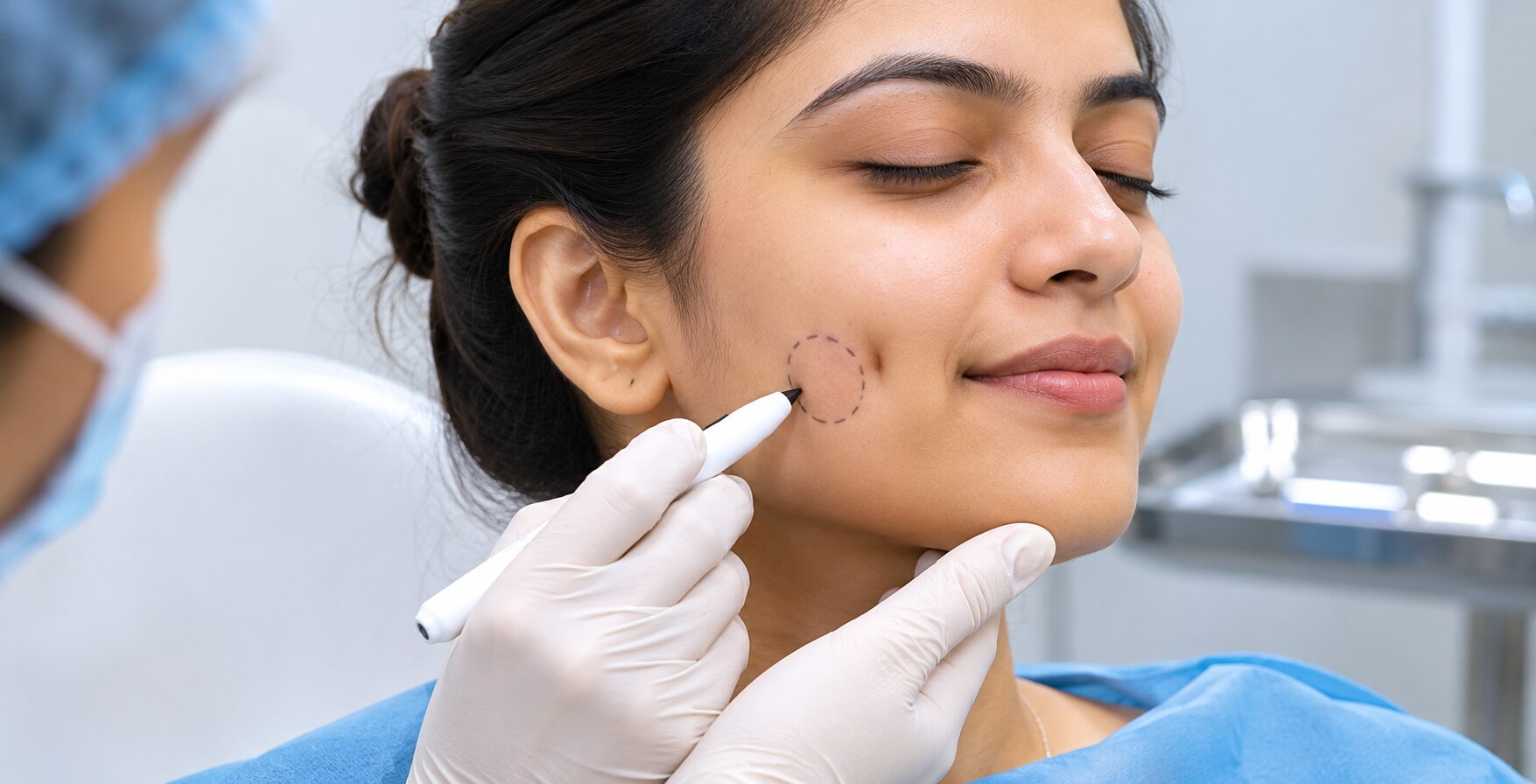
2. Mark the point while your face is relaxed, smiling, laughing, and making several expressions. A position that looks balanced in a reference image can sit too close to the mouth, too low on your cheek, or too far toward the nose on your face.
3. During a dimple location consultation in Borivali, ask to see the markings in a mirror and front-facing photographs at each expression. This reveals whether the proposed dimple is intended to appear mainly during smiling or remain visible at rest.
4. If you already have a natural dimple on one side, discuss whether to mirror it, place the other at a slightly different height, or preserve its individual position. Natural dimple placement follows facial movement and underlying anatomy, not one universal measurement.
Which dimple pattern and visibility should you choose?
Choose the pattern and visibility that fit your facial movement, not a reference photograph. Decide whether you want one dimple or two, a higher or lower cheek position, a point near the corner of the mouth, or a more lateral cheek position. These are distinct cheek dimple surgery choices in Mumbai.
| Option | Appearance | Planning point |
|---|---|---|
| Unilateral | One cheek carries the feature | Suits one existing natural dimple or clear side-to-side difference |
| Bilateral | Both cheeks create a paired look | Mark each side separately when the cheeks or smile are uneven |
| Higher or lower cheek | Changes the dimple’s relationship to the cheekbone and smile | Check the point at rest and during several smiles |
| Corner-of-mouth or lateral | Sits nearer the mouth or farther toward the outer cheek | Compare how each position changes facial balance |
Ask whether the dimple should appear mainly while smiling or remain visible at rest. A dynamic dimple usually looks subtler; a resting dimple creates a stronger feature between expressions, with excessive tethering increasing the risk of a permanently obvious indentation.
Have the surgeon show both the relaxed and animated markings in photographs. A lower cheek point can make the smile appear longer or pull attention downward, while a point near the mouth can make the smile seem narrower or more concentrated.
Unilateral and bilateral designs are not interchangeable, so approve each side on its own anatomy rather than demanding identical points.
How are dimple size, depth, and markings tested?
A dimple size consultation should separate diameter, depth, and dynamic behavior. A small, sharply tethered pit can look more artificial than a broader, shallow depression, while an overlarge mark can dominate the cheek. No universally correct millimetre size exists, and a requested diameter does not reliably predict the final visible result.
Discuss the intended appearance before approving the marking:
| Option | Appearance | What to check |
|---|---|---|
| Soft depression | Broad, shallow contour | Whether it remains natural at rest |
| Defined indentation | Narrower, stronger feature | Whether tethering looks too sharp |
| Dynamic dimple | Deepens mainly during movement | Whether it appears during a natural smile and fades at rest |
| Resting dimple | Visible between expressions | Whether it changes the apparent cheek and smile shape |
Before surgery, ask the clinician to mark the proposed point and inspect it with your face relaxed, during a natural smile, with a broad smile, and in front-facing photographs. A marked circle can look larger when the cheek stretches, while a point can shift toward the mouth during animation.
Compare photographs from several expressions instead of approving a single mirror view.
The first postoperative image is not a dependable measure of planned size. Swelling and inflammation can make the dimple look deeper or wider before tissues settle, so ask when the shape should be judged and avoid treating early appearance as a reason for immediate revision.
What should you bring and ask at a Borivali consultation?
Bring clear, front-facing photographs showing a neutral expression, a relaxed smile, and a broad smile. Add examples of dimples you like, and label each example as a resting dimple, smile-only dimple, narrow pit, or broad depression.
State whether you prefer one side, matched dimples, lower cheek placement, or a position near the mouth. Ask the clinician to document the planned points, show the markings in photographs, and explain why the two sides may differ.
- Ask about cheek thickness, facial symmetry, smile mechanics, and movement around the mouth.
- Disclose previous facial or dental procedures, active oral infection, medicines that affect bleeding, smoking, and any factor that could delay healing.
- Ask how oral wound care will work and what healing changes could affect visibility.
- Ask what revision can and cannot correct instead of accepting a promise of a fixed result.
| Choice | What it means | What to clarify |
|---|---|---|
| One dimple | Treatment on one cheek | Whether it balances an existing natural dimple |
| Matched dimples | A paired appearance | Why identical points may look uneven during smiling |
| Lower cheek | A lower position on the cheek | Whether it changes the apparent smile width |
| Near the mouth | Placement closer to the oral corner | Whether it may look too medial at rest |
For a dimple placement size consultation in Borivali, Dr. Karan Mehta's Mouth Jaw Face & Hair Transplant is one local option; compare whether the provider examines movement, explains markings, covers oral care, and sets clear revision limits.
Related service
Face Dimples make a beautiful smile even better. Some people have a naturally occuring dimples just at their corner of mouth. View service → |
Which healing and revision risks should affect your decision?
An overly deep or persistent dimple can result from excessive tethering between cheek skin and deeper tissue. Dimple creation usually forms this controlled connection with an internal suture or tract; simply removing a small piece of skin does not produce the same movement-related indentation.
| Appearance | Possible explanation | Question to ask |
|---|---|---|
| Deeper or wider early result | Swelling and inflammation | When should the final shape be judged? |
| Visible at rest | Excessive tethering or overcorrection | How will the tether be limited? |
| Softer or faint result | Healing, undercorrection, or recurrence | What revision options exist? |
| Uneven sides | Different healing or placement | How will persistent asymmetry be managed? |
Before consenting, discuss:
- Infection, bleeding, internal scarring, persistent asymmetry, undercorrection, overcorrection, and recurrence.
- What happens if the dimple sits too close to the mouth, remains visible without smiling, fades, or changes position.
- Specific mouth-care, rinsing, diet, and warning-sign instructions. An internal wound still contacts oral bacteria, so it can become irritated or infected.
- Whether active dental or oral infection, smoking, blood-thinning medicines, diabetes, or another poor-healing factor should delay elective treatment.
Revision can release an unwanted tether, but it cannot guarantee restoration of the original cheek. Conservative placement matters because dimple creation is not predictably reversible, and a permanent difference between the cheeks can remain.
Frequently asked questions
What should a dimple consultation measure before marking?
The clinician should compare the proposed point with each mouth corner, cheek prominence, smile line, facial width, cheek fullness and any existing natural dimple.
How do you choose a dimple pattern and visibility?
Discuss whether you want one or two dimples, their position, and how visible they should be at rest, while smiling and during normal facial movement.
How are dimple size, depth and markings tested?
Markings can be checked while your face is relaxed, smiling and speaking. Compare the planned size and depth from the front and both side angles before confirming.
What should you bring to a dimple consultation in Borivali?
Bring reference photos that show the dimple pattern you prefer, a list of previous facial procedures, medical conditions, medicines and specific questions about the planned markings.
Which healing and revision risks should affect your decision?
Discuss swelling, infection, uneven dimples, changes in depth as tissue heals, excessive scarring and the circumstances that could require revision surgery.
Keywords