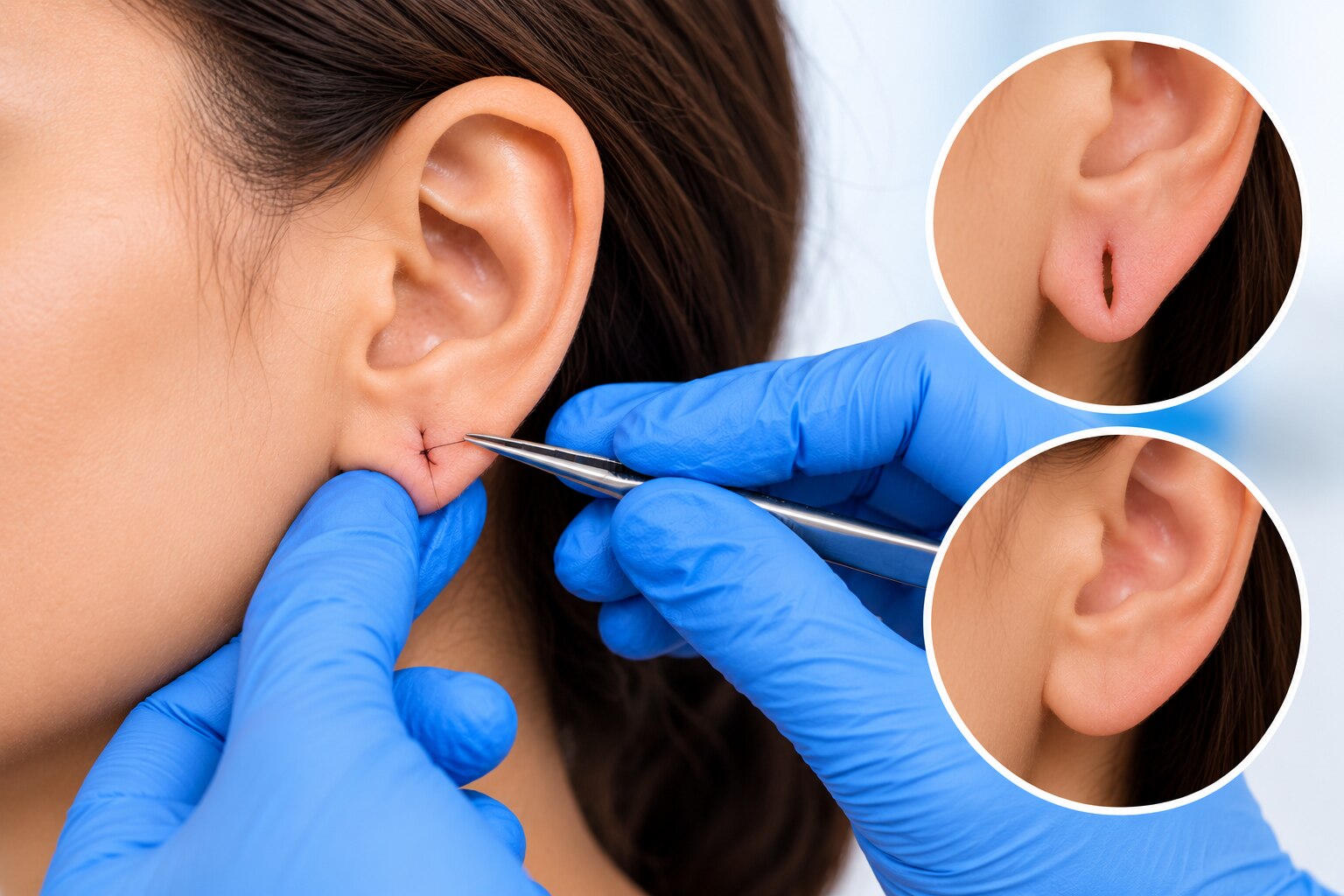
An incomplete slit, a fully torn lobe, an elongated piercing and missing tissue are different problems, so closing each one with the same design can create shortening, notching or renewed stretching. By matching the damage to the repair method, you can compare durability, scarring, downtime and future piercing options before choosing a surgeon.
Key takeaways
- Photograph both lobes and measure the tear before your consultation.
- Choose the technique based on tear direction, tissue loss and rim condition.
- Delay repair during infection, active skin disease or poorly controlled diabetes.
- Ask how contour, tissue thickness and future piercing will be managed.
Identify the Damage Before Choosing a Repair
The defect, not the city, determines which ear lobe repair is right for me mumbai. Before seeking an opinion, photograph both lobes from the front and side and note the tear direction, gap size, tissue thickness, piercing position, skin quality and whether the lower rim remains intact.
| Damage | What it looks like | Why it matters |
|---|---|---|
| Partial split | Slit that stops before the lower edge | Scar trimming and direct closure may preserve more tissue |
| Complete tear | Lobe divided into two segments | The epithelialised cleft usually needs removal and layered closure |
| Elongated hole | Piercing opening pulled downward | Closure must restore the hole’s shape and lobe contour |
| Stretched lobe | Thin tissue after large-gauge jewellery | Circumferential trimming and reshaping may be needed |
| Thin or absent tissue | Narrow rim or missing lower lobe | A local flap, tissue rearrangement or staged reconstruction may replace lost tissue |
| Infected piercing | Redness, warmth, discharge or worsening tenderness | Infection needs treatment before definitive cosmetic repair |
| Fresh avulsion | Recent tear with bleeding or detached tissue | Urgent cleaning, assessment and selective removal of damaged tissue take priority |
| Previous repair defect | Notch, asymmetry or recurrent split after surgery | Scar quality and remaining blood supply determine revision planning |
A protruding ear is a different problem. Prominent-ear surgery changes ear projection; lobe repair restores a damaged rim or piercing site.
Seek urgent assessment for bleeding, contamination, severe pain or detached tissue rather than booking routine cosmetic surgery. An active infection also needs medical attention, not immediate elective closure.
Match the Defect to the Surgical Technique
A narrow partial tear usually suits scar-edge trimming and direct closure, provided enough healthy tissue remains and the piercing hole does not extend to the lower rim. The simplest earlobe repair options Mumbai clinics offer can become unsuitable if removing scar shortens, narrows or distorts the lobe.
| Defect | Technique | Main reason |
|---|---|---|
| Narrow partial tear | Scar trimming with direct closure | Repairs a limited gap without unnecessary tissue removal |
| Complete split | Remove the epithelialised cleft, then close front, deeper tissue and skin in layers | Restores strength and aligns the free margin |
| Large-gauge opening | Circumferential trimming and reshaping | Treats stretched tissue instead of merely stitching the hole shut |
| Thin or missing lower rim | Z-plasty, L-plasty or another local flap | Redistributes tension, lengthens contracted scar and reduces a straight-line notch |
| Major tissue loss or avulsion | Local tissue rearrangement or staged reconstruction | Supplies coverage when direct closure would be tight or impossible |
In complete tears, precise free-margin alignment matters: a step, notch or over-tight closure can leave a visible deformity. Z-plasty and L-plasty add scar lines, so they are not automatically better than linear closure.
Stretched earlobe repair after gauge jewellery may require reshaping around the entire opening. If the lower rim has substantial loss, a local flap or staged earlobe reconstruction can preserve contour more reliably than one straight closure.
For torn earlobe surgery Mumbai patients, the decision depends on tear direction, gap size, tissue thickness, skin quality, prior repairs and the blood supply of the remaining lobe—not the procedure name alone.
Know When Repair Should Wait—and What You Trade Off
An open or contaminated wound is not ready for definitive contour repair. Delay surgery for active piercing infection, uncontrolled diabetes, or a recent traumatic tear that still needs cleaning, bleeding control and assessment of tissue viability.
Tell the surgeon about:
- Smoking or vaping
- Aspirin, warfarin, apixaban or other blood-thinning medicines
- Previous ear operations
- Poor wound healing
- A personal or family history of keloid or hypertrophic scars
Do not stop a prescribed anticoagulant without advice from the clinician who prescribed it. In keloid-prone skin, surgery can produce a larger recurrent scar; ask whether silicone, pressure treatment or steroid-based care belongs in the plan.
Repair can restore the contour and preserve a future piercing site, but it brings local anaesthesia, wound care, a healing scar and a temporary jewellery restriction. Notching, asymmetry, recurrent splitting and a larger keloid remain possible. Torn earlobe surgery in Mumbai is therefore not automatically the best choice if the appearance causes little concern.
Leaving the lobe alone avoids surgical downtime but preserves the split or stretched appearance. A temporary earring support can reduce traction on an elongated hole; it cannot replace missing tissue or close a complete tear.
Do not re-pierce through fresh scar tissue. The scar needs to mature and gain strength first, with timing based on the technique, tissue quality and healing rather than a fixed two-week promise. Stretched earlobe repair may restore a piercing site, but only after the surgeon confirms that the repaired rim can support jewellery.
Use the Consultation to Plan Contour, Tissue and Future Piercing
A useful earlobe reconstruction consultation should map the defect before anyone selects a technique. Examine both lobes from the front and side, measure the gap or stretched opening, inspect the scar and lower rim, and take photographs when they clarify asymmetry.
Ask about allergies, diabetes, smoking, medicines that increase bleeding, previous repairs, keloids or hypertrophic scars, and the timing and cause of the injury. This history affects wound healing, scar risk and whether a straightforward closure is sensible.
| Priority | Design question | Planning consequence |
|---|---|---|
| Natural contour | Is lobe length, roundness or a smooth lower rim most important? | The repair must avoid a notch, step or excessive tension. |
| Future piercing | Do you want the original piercing restored, or a new position? | Remaining tissue must be thick and strong enough to support it. |
| Matching | Should the repaired lobe match the opposite side? | The surgeon compares height, width, angle and asymmetry. |
| Heavier jewellery | Will you wear large or heavy earrings? | The design needs stronger tissue and a piercing position that limits traction. |
Ask whether the remaining tissue can support a new piercing. Thin or absent lower-rim tissue may require a local flap, tissue rearrangement or staged reconstruction instead of direct closure.
Repair does not make the lobe immediately ready for earrings. Re-piercing waits until the scar has matured and the surgeon confirms adequate strength; timing depends on the technique and tissue quality.
For a local assessment, Dr. Karan Mehta's Mouth Jaw Face & Hair Transplant is one Mumbai clinic to contact, while you compare its proposed design with other qualified opinions.
Related service
Face Ear shape and position have a standard although individual variations may exist. View service → |
Compare Surgeons by the Plan They Propose, Not the Procedure Name
Compare earlobe repair options Mumbai clinics by the plan, not the procedure label. Ask who will operate, their surgical training and registration, and whether the procedure occurs in an appropriately equipped clinic or hospital. Then ask why the design fits your tear direction, tissue thickness, gap size and skin quality.
That is how you answer “which ear lobe repair is right for me Mumbai” without choosing by a short name or advertised recovery time.
| Option | What it means | When it may fit |
|---|---|---|
| Direct layered closure | Removes healed scar and closes deeper tissue and skin in layers | Small, narrow defect with enough rim and low tension |
| Scar release with Z-plasty or L-plasty | Rearranges scar lines and redistributes tension | Contracted scar, threatened notch or a lobe that would shorten |
| Local flap reconstruction | Moves adjacent tissue while preserving its blood supply | Tissue loss, thin lower rim or a closure that would distort the lobe |
| Staged treatment | Rebuilds in planned steps | Major avulsion, poor scar quality or insufficient tissue for safe closure |
Ask how long local anaesthesia usually takes, how to protect the dressing, when sutures come out, when you can work, and how many reviews are planned. Ask what happens if healing leaves a notch, recurrence or a thick scar, including scar treatment and revision options.
Confirm how the surgeon will preserve lobe length and blood supply after earlier repair or traumatic tissue loss. Re-piercing depends on scar maturity and strength, so reject a fixed promise; the right plan protects future jewellery choices and states its limits.
Frequently asked questions
How do I identify the damage before choosing ear lobe repair?
Assess the tear direction, gap size, tissue thickness, piercing position, skin quality and whether the lower rim remains intact. Photograph both lobes from the front and side before your consultation.
Which surgical technique matches a stretched or torn earlobe?
A straight split with healthy tissue may need direct edge repair. A widened piercing may require removal of the stretched tract and reshaping. Tissue loss, a missing lower rim or a complex split may need flap-based earlobe reconstruction.
When should earlobe repair wait?
Repair should wait during infection, open skin disease or uncontrolled medical conditions that increase healing risk. Waiting can improve safety, but prolonged stretching can leave more tissue loss and alter the reconstruction plan.
What should I ask during an earlobe reconstruction consultation?
Ask how the surgeon will restore contour, preserve or replace tissue, position the scar, manage asymmetry and decide whether future piercing is safe. Compare the proposed plan rather than relying on the procedure name alone.
Keywords