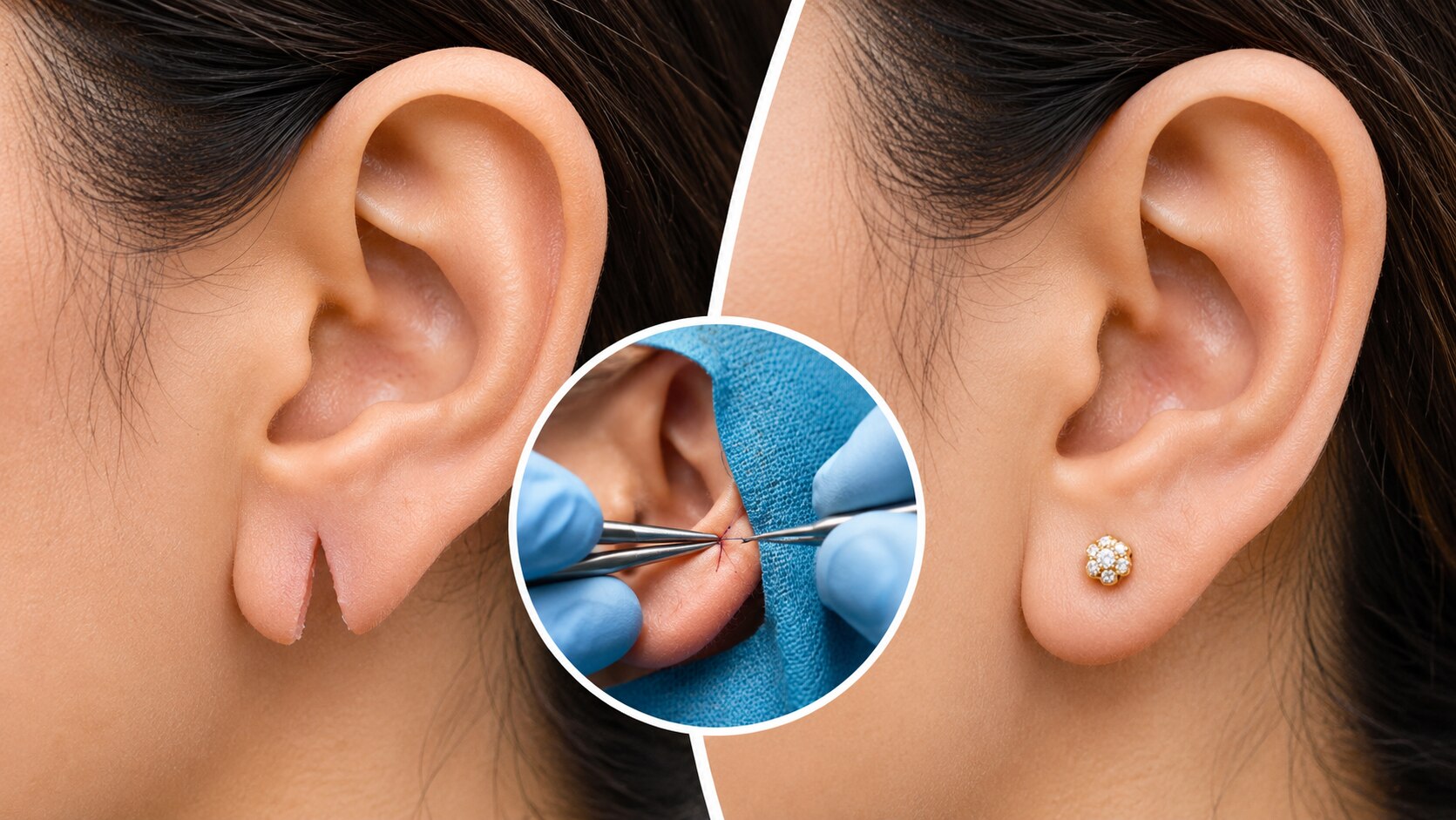
A split, stretched, notched, or traumatically damaged earlobe does not receive the same repair design. You will learn how the surgeon identifies the defect, prepares and closes the tissue, and manages healing, sutures, warning signs, and the timing of a new piercing.
Key takeaways
- Ask how much tissue and scar will be removed before closure.
- Disclose diabetes, smoking, keloids, allergies, and blood-thinning medicines.
- Confirm whether edge-to-edge closure can repair your specific tear.
- Ask when sutures come out and when a new piercing is safe.
What the Surgeon Checks Before Choosing a Repair
The surgeon first measures the tear, checks the remaining soft tissue, and inspects skin quality, scar tissue, infection, and the position of the original piercing. They also ask about previous repairs, keloids or hypertrophic scars, diabetes, smoking, bleeding disorders, allergies, anticoagulants, and your preferred future earring position.
These findings determine whether the lobe can be closed directly or needs reshaping.
| Defect | What the examination shows | Likely repair choice |
|---|---|---|
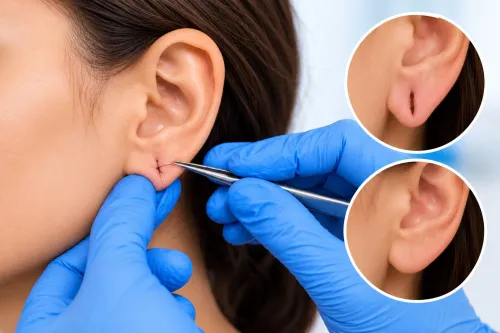
| Complete tear | The lobe is split through its full thickness, often with an epithelialized lining | Remove the lining, refresh the edges, then use layered closure |
| Partial tear | A bridge of tissue remains, but the opening is lengthened or notched | Preserve healthy tissue and close or reshape the defect |
| Elongated piercing | The hole is stretched without a full split | Reduce or excise the enlarged tract, depending on tissue quality |
| Gauge hole | A large circular opening has insufficient edge support | Plan tissue rearrangement; extensive loss may require a flap or graft |
| Traumatic loss or irregular tear | Tissue is missing, scarred, or uneven | Design a reconstruction that restores contour and symmetry |
Your expectations matter: a repair aimed at a level lower piercing differs from one aimed only at closing the split. Discuss infection, bleeding or haematoma, wound separation, asymmetry, notching, numbness, scarring, and recurrence from heavy earrings.
The phrase ear lobe repair surgery for steps borivali describes a location search, not a separate operation; the core ear lobe reconstruction steps remain the same.
What Happens During the Earlobe Repair Procedure
Most uncomplicated repairs are outpatient procedures under local anaesthetic, so you remain awake while the surgeon works. An earlobe repair procedure in Mumbai commonly takes less than an hour; complex scarring or a previous repair can extend the operating time.
1. The surgeon confirms the planned repair, marks the tear or stretched opening, and photographs or measures the lobe when needed. Marking helps preserve symmetry between both ears.
2. The skin is cleaned with an antiseptic solution, and sterile drapes keep the working area clear. Local anaesthetic is injected around the lobe; the injection stings briefly, then pressure replaces sharp pain.
3. The surgeon removes the thin epithelialized lining, scarred edges, or irregular tissue. This creates fresh wound surfaces that can join properly instead of leaving a weak channel.
4. If the lobe has enough tissue, the edges are reshaped and brought together directly. Tissue loss or an uneven defect can require rearranging nearby tissue before closure.
5. Fine sutures close the repair in layers, aligning the skin edge without pulling it downward. The surgeon checks the contour, bleeding, and symmetry before placing a small dressing.
6. You receive written instructions covering cleaning, dressing changes, prescribed medication, warning signs, and the follow-up visit. After observation for a short period, you can usually leave with someone else driving if the anaesthetic or medication affects you.
When a Simple Edge-to-Edge Closure Is Not Enough
A straight edge-to-edge closure works only when both sides have enough healthy tissue to meet without tension. Inadequate tissue, gauge holes, irregular tears, repeated trauma, or tissue loss require reconstruction rather than simply stitching the edges together.
- Inadequate tissue may require reshaping the remaining lobe before layered closure. If direct closure would pull the lobe downward, a local flap can bring healthy tissue into the gap.
- A stretched gauge hole usually needs removal of the epithelialized inner lining and excess scarred tissue. The surgeon then rebuilds the lobe contour instead of closing the opening as a narrow slit.
- An irregular tear needs careful trimming and alignment of uneven edges. A Z-plasty or W-plasty-type design can reduce a notch and distribute tension across the repair.
- Repeated tearing calls for stronger layered suturing and a plan to remove traction from heavy earrings. Repair can recur if the lobe is stretched again.
- Major tissue loss can make a flap or, rarely, a graft necessary. The available skin, blood supply, scar quality, and symmetry determine the design.
The ear lobe reconstruction steps therefore extend beyond marking and stitching: scar removal, contour planning, tissue rearrangement, layered closure, and written restrictions may all be needed. During an earlobe repair procedure in Mumbai, ask how much tissue remains and whether the proposed closure addresses future piercing.
The First Days, Suture Removal, and Full Healing
Expect mild swelling, tenderness, bruising, and a small dressing during the first few days. Keep pressure, friction, and traction off the repaired lobe; sleep on the opposite side and follow the dressing instructions exactly. Do not swim or apply creams, oils, or antiseptics unless your surgeon approves them.
Non-absorbable skin sutures are often removed after 5–10 days. The exact day depends on skin tension, closure type, and suture material; absorbable stitches may disappear without removal. Never pull visible threads, even if they loosen.
During torn earlobe surgery recovery, protect the incision from anything that could pull the edges apart. Contact the surgeon promptly if you notice:
- Increasing pain, warmth, redness, swelling, or pus
- Persistent bleeding or a rapidly enlarging bruise
- Wound separation, fever, or a darkening wound edge
The surface may look healed before the deeper repair has regained strength. Wait until the wound is fully closed and your surgeon clears you, often several weeks to a few months, before considering a new piercing.
A piercing placed directly through the scar can split the lobe or heal poorly, so ask whether it should sit to one side of the repair.
Healing advice varies with the repair design and your skin. For ear lobe repair healing in Borivali, confirm the follow-up date, permitted products, warning signs, and recommended re-piercing position before leaving the clinic.
Questions to Confirm at a Borivali Consultation
Before booking, confirm the surgeon’s plan, not just the procedure name. For ear lobe repair surgery steps, Borivali patients should ask whether the tear is partial, complete, stretched, or affected by tissue loss, and how that finding changes closure, sutures, and expected symmetry.
- Will you remove the epithelialized lining and scar tissue before closing a complete split?
- Which anaesthetic, suture material, dressing, and scar-care instructions will you use?
- How many follow-up visits are included, when will sutures come out, and who handles an urgent problem after hours?
- What total fee covers the surgeon, facility, medicines, dressings, and any review?
- When can you swim, sleep on that side, wear earrings, and consider re-piercing?
Confirm that your record includes keloids or hypertrophic scars, diabetes, smoking, bleeding disorders, allergies, previous repairs, and medicines such as anticoagulants. These details can alter wound planning and complication risk.
| Option | What to confirm | Why it matters |
|---|---|---|
| Simple closure | Edge preparation and layered sutures | A weak edge-to-edge repair can separate or leave a notch |
| Tissue rearrangement | Flap design or graft requirement | Tissue loss or a large gauge hole needs more than direct closure |
| Future piercing | New site and minimum waiting period | Piercing too soon can reopen the repair |
For ear lobe repair healing, Borivali clinics may differ in restrictions and follow-up. Dr. Karan Mehta's Mouth Jaw Face & Hair Transplant is one local clinic where you can use these questions to compare the proposed plan rather than relying on a generic timeline.
Related service
Face Ear shape and position have a standard although individual variations may exist. View service → |
Frequently asked questions
What does a surgeon check before ear lobe repair?
The surgeon measures the tear, assesses remaining soft tissue and skin quality, examines scar tissue or infection, and notes the original piercing position. Tell them about previous repairs, keloids, diabetes, smoking, bleeding disorders, allergies, anticoagulants, and your preferred future piercing site.
What happens during an earlobe repair procedure?
The surgeon removes damaged or scarred edges, brings the healthy tissue together, and closes the repair with sutures. The exact closure depends on the tear length, tissue available, scar pattern, and skin condition.
When is simple edge-to-edge closure not enough?
A basic closure may not suit a large split, stretched piercing, missing tissue, thin tissue, or a repair with heavy scarring. The surgeon may need to reshape the edges or use a local tissue flap to restore the earlobe contour.
How long does torn earlobe surgery recovery take?
Keep the repair clean, follow wound-care instructions, and avoid pressure or pulling from earrings. Sutures are removed at the appointment set by your surgeon; the scar continues to mature after the skin closes, and you should confirm when repiercing is safe.
Keywords