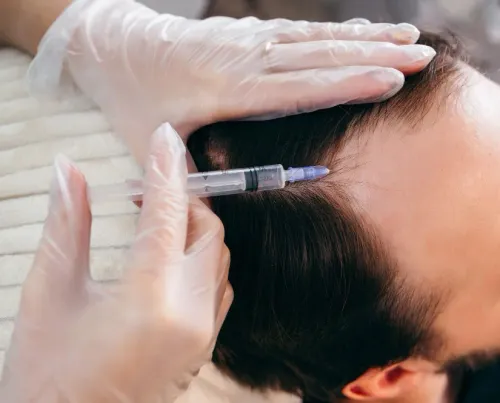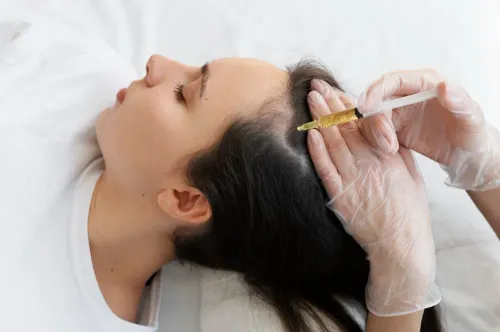
Hair thinning can gradually change the appearance of the hairline, temples and crown. Medicines and non-surgical therapies may help control certain types of hair loss, but they cannot always restore follicles in areas that have become permanently bald. In suitable cases, an FUE hair transplant may offer a restorative option.
Mouth Jaw Face Clinic (MJF Clinic) is led by Dr. Karan Mehta, an MDS-qualified Oral and Maxillofacial Surgeon with a Fellowship in Aesthetic Medicine from ILLAMED, affiliated with Greifswald University, Germany. His fellowship includes training in hair transplant surgery, supporting his knowledge of hairline planning, follicular extraction and facial proportion.
What Happens During an FUE Hair Transplant?
Follicular Unit Extraction, commonly called FUE, involves removing individual follicular units from a donor area and implanting them into thinning or bald regions. The donor follicles are usually taken from the back or sides of the scalp, where hair is often more resistant to pattern hair loss.
The procedure generally includes:
- Scalp assessment: The pattern of hair loss, donor density and scalp health are examined.
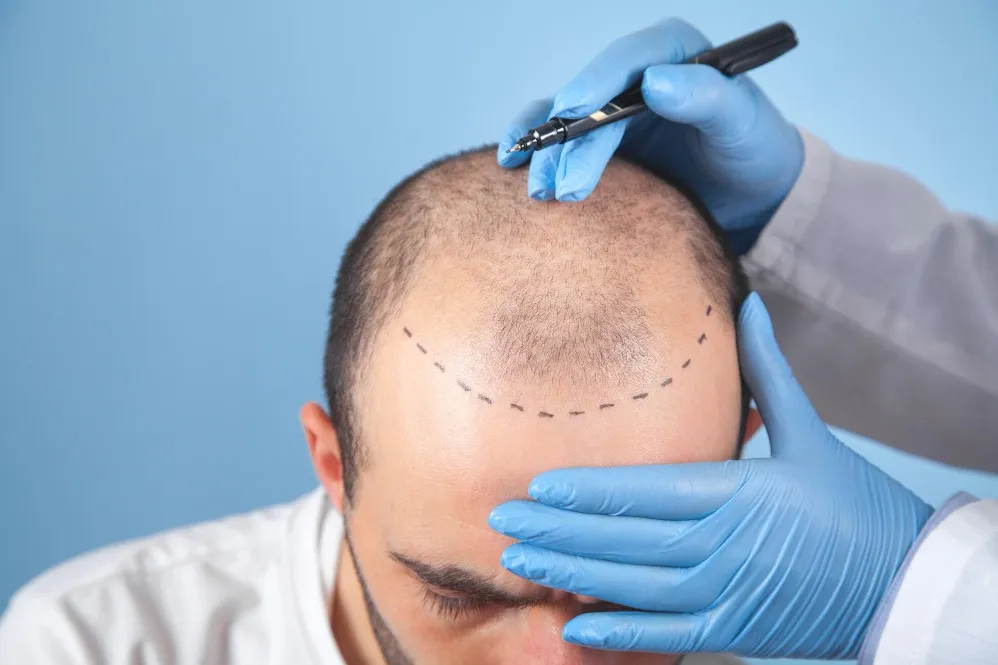
- Hairline planning: The proposed hairline is designed according to age, facial proportions and existing hair.
- Donor preparation: The donor region is trimmed and prepared under sterile conditions.
- Follicle extraction: Individual follicular units are removed with a small punch instrument.
- Graft preparation: The extracted follicles are sorted and preserved.
- Recipient-site creation: Small openings are made at appropriate angles and directions.
- Graft placement: The follicles are positioned to produce natural-looking distribution and coverage.
FUE Hair Transplant Assessment in Borivali West
Not every person experiencing hair loss is automatically suitable for transplantation. Candidacy depends on the cause and stability of hair loss, donor-hair availability, scalp health and realistic expectations.
FUE may be considered for people with:
- Male or female pattern hair loss
- Receding temples
- A changing frontal hairline
- Localised thinning over the crown
- Hair loss involving selected stable scars
- Adequate donor density at the back or sides
Active scalp infections, uncontrolled medical conditions or rapidly progressing unexplained hair loss may require evaluation and treatment before surgery is considered.
Does FUE Leave Scars?
FUE removes individual follicular units rather than a strip of scalp. It therefore avoids the long linear donor scar associated with strip-based transplantation. Small dot-like extraction marks may remain, although they are generally difficult to notice after healing when the donor area is managed appropriately.
FUE should not be described as completely scar-free. Every surgical extraction produces some degree of tissue healing, and the visibility of marks depends on skin characteristics, punch size, extraction pattern and haircut length.
Recovery and Hair-Growth Timeline
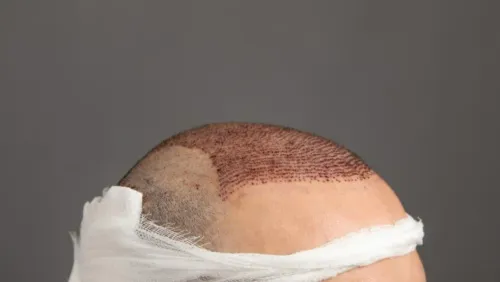
Mild redness, swelling, sensitivity and temporary crusting may occur during the initial recovery period. Patients receive instructions regarding scalp washing, sleeping position, exercise and protection of the implanted area.
Some transplanted hair shafts commonly shed during the early weeks. This does not necessarily mean the follicles have been lost. New hair appears gradually as the transplanted follicles enter another growth cycle, and density continues to mature over several months.
Considering an FUE hair transplant in Borivali? Consult Dr. Karan Mehta at MJF Clinic for a scalp and donor-area evaluation, estimated graft requirement and realistic discussion of the coverage that may be achieved.
Keywords