Sparse eyebrows do not all have the same cause, so the right solution depends on whether you have missing follicles, active hair loss, scarring, low natural density, or a brow that has simply descended. By the end, you will be able to separate cases that need diagnosis from those suited to transplantation, compare FUE, FUT, donor-hair sources, and non-surgical choices, and prepare for a more useful Mumbai consultation.
Key takeaways
- Transplant stable gaps; treat ongoing hair-pulling or active loss first.
- Choose a lift for sagging skin, not missing eyebrow hairs.
- Match single-hair grafts and growth direction to your natural brow.
- Ask about donor source, graft count, healing, trimming, and revision plans.
Does my pattern of eyebrow loss make me suitable for transplantation?
Stable empty areas are more straightforward transplant candidates than brows that are still losing hair. Over-plucking, congenital sparsity, age-related thinning, trauma, burns, and surgery can leave predictable gaps or scars; trichotillomania can do so while hair-pulling continues.
Alopecia areata, frontal fibrosing alopecia, thyroid disease, nutritional deficiency, infection, or another disorder requires diagnosis before you choose surgery.
| Pattern or cause | What it suggests | Transplant timing |
|---|---|---|
| Over-plucking, congenital sparsity, age-related thinning | Stable low density or gaps | Consider after confirming stability |
| Trauma, burns, or surgery | Scarred or follicle-free skin | Consider when the scar and loss are stable |
| Trichotillomania | Ongoing mechanical loss | Delay until hair-pulling is controlled |
| Alopecia areata or frontal fibrosing alopecia | Autoimmune or scarring loss may continue | Assess and stabilize disease first |
| Thyroid disease or nutritional deficiency | A treatable systemic cause | Test and treat before surgery |
| Sudden shedding, infection, or inflammatory disease | An unexplained or active process | Diagnose and control it first |
- Begin with a medical history, scalp and brow examination, and donor-area assessment, not a graft-count promise. Targeted tests such as thyroid function, iron studies, ferritin, vitamin B12, or vitamin D testing are useful when your history or examination indicates them.
- Active autoimmune loss, inflammatory skin disease, infection, sudden unexplained shedding, or ongoing pulling can cause transplanted hairs to fail or leave new gaps. Stabilization matters more than cosmetic preference.
- Asking “which eyebrow transplant option is right for me, Mumbai?” is premature until eyebrow transplant suitability is established. A surgeon then compares your desired shape with donor supply, skin quality, existing hairs, and the maintenance you accept.
When is a non-surgical brow option or a lift better than a transplant?
Pencils and powders are the fastest choice for eyebrow restoration for sparse brows: they cover gaps immediately, wash off, and require daily application. Tinting darkens existing hairs but cannot fill empty skin. Mild, stable thinning may therefore suit camouflage or diagnosis-led medical treatment better than surgery.
| Option | Skin penetration | Appearance, maintenance and reversibility |
|---|---|---|
| Pencils or powders | None | Immediate coverage; fully reversible; remove daily |
| Tinting | None | Darkens existing hairs; lasts until hairs shed; does not fill gaps |
| Microblading or nano brows | Pigment enters the skin | Hair-like strokes; fade, change colour, and need touch-ups; less reversible |
| Scalp micropigmentation | Pigment enters the skin | Creates a shadow, not living hairs; requires maintenance and touch-ups |
Microblading and nano brows provide speed without adding follicles. Scalp micropigmentation has the same limitation: it creates visual density rather than growing hair. Transplantation is slower and more invasive, but it redistributes living follicles for a longer-term result; those hairs still need ongoing trimming.
A brow and forehead lift fits eyebrow descent, forehead laxity, hooding, or asymmetry caused by brow position. It changes height and shape, not follicle numbers, so it cannot restore missing brow hairs. Treat an underlying disorder such as alopecia, thyroid disease, inflammation, or nutritional deficiency before any cosmetic procedure.
Choose surgery only after the loss is stable and you accept its permanence.
Which transplant method, donor source, and graft design match my brows?
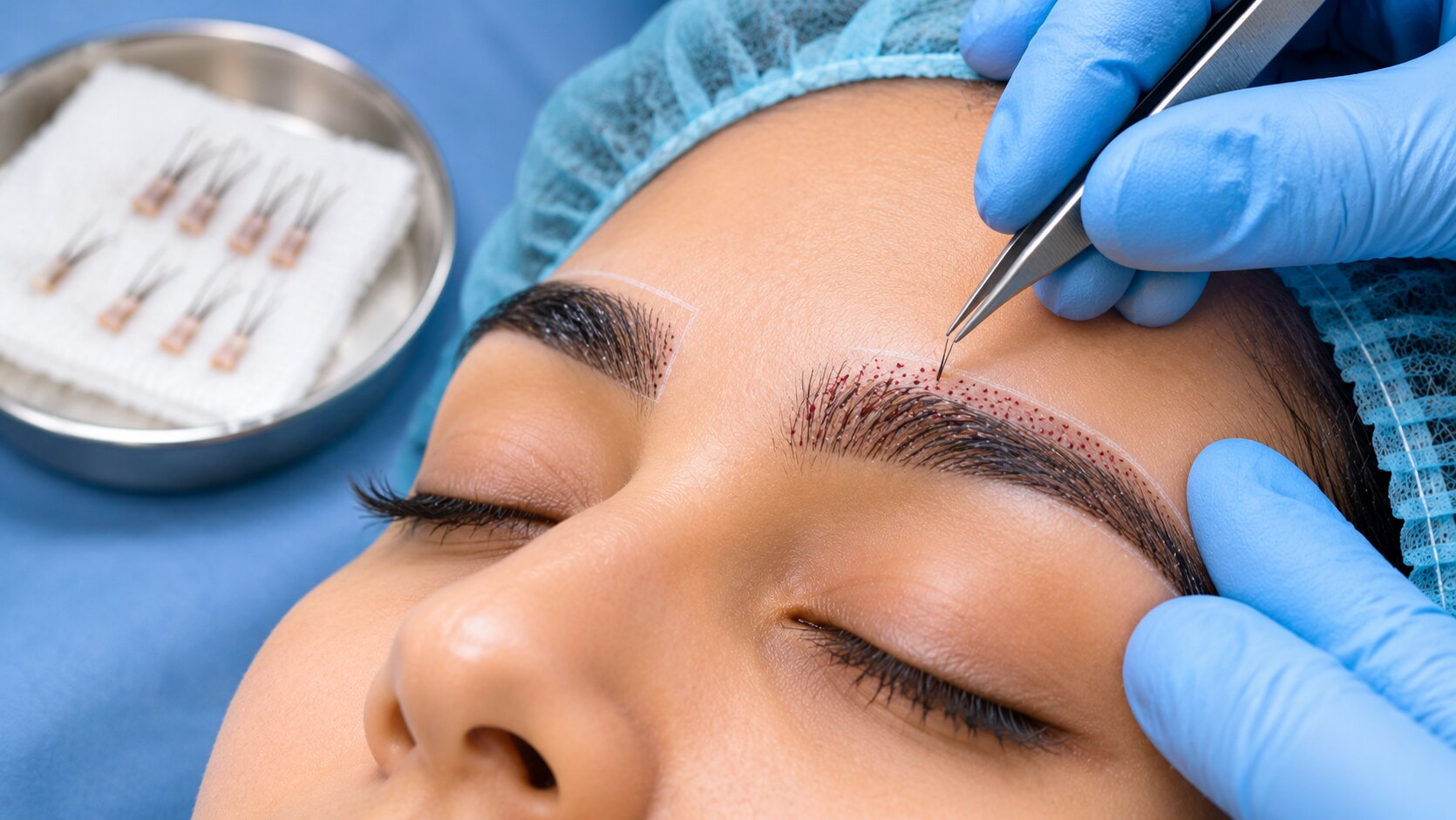
FUE removes individual follicular units and avoids a linear scalp scar, making it the usual choice for a small brow-only session. FUT removes a scalp strip, supplies grafts, but leaves a linear scar and is less commonly selected for eyebrow restoration.
| Donor or method | Practical characteristics | Likely brow fit |
|---|---|---|
| FUE scalp | Usually finer, straighter hair with useful density and colour matching; scalp growth rate and long growth cycle remain | Common choice, but requires trimming |
| FUT scalp | Similar hair quality to scalp FUE, with strip harvesting and a linear scar | Considered less often for a limited session |
| Beard hair | Often coarser, darker, curlier, and different in growth cycle | A compromise when scalp supply is unsuitable; mismatch can show |
| Other body hair | Calibre, curl, colour, density, growth rate, cycle, and survival vary widely | Not an interchangeable substitute for scalp hair |
A Mumbai plan for eyebrow transplant grafts may quote roughly 100–350 grafts per eyebrow, but gaps, a missing tail, a scar, and near-total reconstruction need different counts. Single-hair grafts, or carefully trimmed grafts containing one usable hair, matter more than the largest total; multi-hair grafts can look clumped.
Design requires thicker medial brows, a measured arch, matched left and right outlines, and changing direction from head to arch to tail. Implantation must follow each hair’s direction at a very low angle.
Scalp hair keeps growing like scalp hair, so trimming may be needed every few days to weeks; body hair does not remove that mismatch automatically.
What result, maintenance, and risks should I accept before choosing surgery?
An eyebrow transplant permanently redistributes follicles; it does not create new ones or increase your donor supply. Scalp follicles placed in the brow usually shed first, so early sparse growth does not prove failure.
| Stage | What to expect |
|---|---|
| Initial shedding | Implanted hairs commonly fall out after placement |
| Visible growth | Assess progress over several months, not days |
| Final review | Judge the cosmetic result around 9–12 months; consider refinement for density, asymmetry, or direction |
The trade-offs are significant. Poor growth or graft loss can leave gaps, while an incorrect angle or excessive density can make the brow look artificial. Poorly placed recipient sites can injure existing brow hairs and produce asymmetry. Infection, folliculitis, cysts, and visible donor scarring are additional risks.
Transplanted scalp hair keeps growing, so trimming becomes a lifelong task, sometimes every few days to weeks.
Choose surgery when:
- Hair loss is stable and the donor area contains enough suitable follicles.
- One-hair grafts can reproduce the brow’s fine texture and changing direction.
- You accept delayed growth, possible refinement, and regular trimming.
Delay or reject surgery when active disease is present, expectations exceed what the donor supply can provide, or hair-pulling continues. Treat uncontrolled inflammation or infection first; otherwise transplanted hairs can fail while the original loss progresses.
What should I ask at a Mumbai eyebrow-transplant consultation?
Leave the consultation with a written record, not a promised graft number or survival percentage. Compare providers using the same questions and photographs.
- What is the diagnosis, or working diagnosis, for my loss pattern? How will active alopecia, thyroid disease, scarring, nutritional deficiency, infection, or ongoing hair-pulling be treated before surgery?
- Will you examine existing brow hairs, skin, and the donor area in person? Please take close-up photographs in consistent lighting and angles.
- Show me the proposed outline, medial brow thickness, arch and tail position, hairline, and left-right symmetry.
- What graft count do you estimate, and how many will be one-hair grafts versus multi-hair grafts?
- Which extraction method and donor site do you recommend? Explain why that source suits my hair calibre, curl, colour, and growth rate.
- What trimming schedule should I expect, what is the likely growth timeline, and what are the risks?
- If growth is incomplete, or direction and density are poor, what correction or refinement plan applies?
Record the answers here:
| Item | What to document |
|---|---|
| Diagnosis | Cause, stability, tests, and treatment before surgery |
| Design | Outline, medial thickness, arch, tail, angle, and symmetry |
| Surgery | Graft estimate, graft type, extraction method, donor site |
| Aftercare | Shedding, growth milestones, trimming, risks, incomplete-growth plan |
In Borivali West, Mumbai, Dr. Karan Mehta's Mouth Jaw Face & Hair Transplant is one local setting where you can discuss facial anatomy, diagnosis, hair restoration, and realistic graft planning with a specialist instead of choosing from photographs alone.
Related service
Hair Here's how the eyebrow transplantation process generally works: Donor Hair Extraction: The surgeon will first identify a suitable donor area on the... View service → |
Frequently asked questions
Does my pattern of eyebrow loss make me suitable for transplantation?
Stable empty areas from over-plucking, congenital sparsity, ageing, trauma, burns, or surgery are more predictable candidates. Active hair-pulling from trichotillomania must be addressed before surgery.
When is a non-surgical brow option or a lift better than a transplant?
Choose a non-surgical option when you need temporary cosmetic coverage or are not ready for surgery. A brow lift addresses drooping or excess skin; it does not replace missing eyebrow hairs.
Which transplant method, donor source, and graft design match my brows?
Your consultation should compare extraction methods, donor areas, and graft design. Single-hair grafts placed at the correct angle and direction are important for a natural-looking brow.
What result, maintenance, and risks should I accept before choosing surgery?
Discuss the expected density, growth timeline, regular trimming, uneven growth, infection, scarring, poor growth, and the possibility of revision before consenting.
What should I ask at a Mumbai eyebrow-transplant consultation?
Ask how your loss pattern affects suitability, where grafts will come from, how many grafts are planned, who performs each step, what recovery involves, and how revisions are handled.
Keywords